In May 2026, a fire at the NorthC data center in Almere, the Netherlands, caused a major disruption to Vonage’s SMS services. Some customers lost access to key services such as SMS API, Messages API, and Verify API, while some systems took more than 36 hours to recover. An additional issue affecting the Numbers Deactivation API, linked to the same incident, continued until May 11, four days after the fire.
Vonage confirmed that the disruption was caused by a fire at a data center operated by one of its infrastructure partners. As a result, systems hosted at that location lost connectivity completely. The company also stated that most customers regained service within a few hours after traffic was redirected to a backup data center.
This is the part that raises the most questions. If failover mechanisms were already in place, why did some customers have to wait more than a day and a half for services to be restored?
For businesses that use SMS for user authentication, 2FA codes, operational alerts, or customer communications, 36 hours of downtime is far more than an inconvenience. It is a serious business risk.
The impact of the fire went beyond Vonage. The same facility also hosted IBM Cloud’s AMS03 data center, which was affected by the outage as well. Utrecht University and public transport operator Transdev also reported service disruptions.
A single fire in a single building was enough to disrupt services used by multiple organizations at the same time. It shows how seemingly independent services can depend on the same infrastructure, creating a shared point of failure.
The Almere incident highlights one of the key risks of the cloud model: dependence on infrastructure managed by third parties.
Even the largest CPaaS providers and SMS API vendors rely on physical data center infrastructure. As a result, the failure of a single critical component can affect services used by thousands of users and organizations.
Cloud providers offer redundancy, disaster recovery procedures, and high-availability features. However, the fire in Almere showed that even a well-designed architecture does not guarantee that services will be restored as quickly as businesses expect.
When critical processes such as user authentication, alerting, or customer communications depend on a single CPaaS provider, organizations also inherit part of that provider’s infrastructure risk.
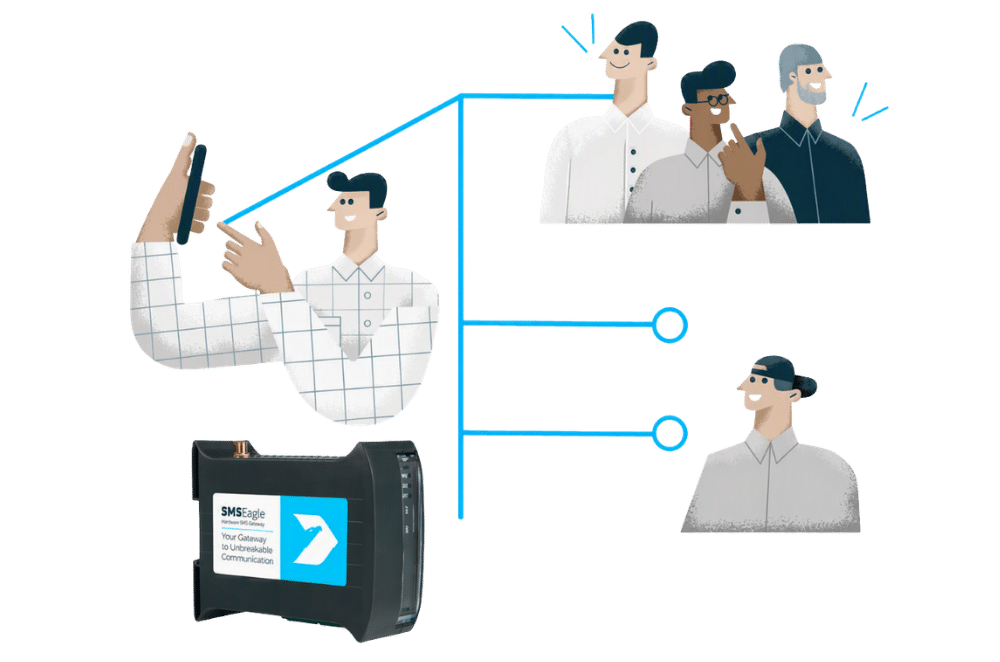
A hardware SMS gateway such as SMSEagle works in a completely different way. The device runs inside the customer’s own infrastructure, uses its own SIM cards, and connects directly to mobile networks. It does not depend on a centralized CPaaS platform or on a data center operated by an SMS service provider.
An on-premises SMS system gives organizations full control over:
In practice, this means that an outage at an external data center does not automatically lead to a loss of SMS capabilities.
An incident at the Almere facility would not affect a device running inside the organization’s own infrastructure. The point of failure that affected multiple providers at the same time simply does not exist in an on-premises setup.
Multi-modem SMS gateways, such as the MHD-8100, can use multiple SIM cards and mobile operators at the same time. The organization decides how resilient the system should be instead of relying entirely on a provider’s architecture.
Local failover mechanisms work automatically. There is no need to reroute traffic between distant data centers or wait for external technical teams to take action.
2FA codes, security alerts, monitoring alarms, and industrial notifications need to be delivered immediately. In these situations, a lengthy outage can create operational, security, and compliance risks.
At the same time, it is important to remember that on-premises solutions do not eliminate every risk. Local infrastructure failures or mobile carrier issues can still happen. What they do remove is dependence on a centralized CPaaS platform and shared data center infrastructure that can become a single point of failure.
The fire in Almere was an unexpected event. However, the fact that a single infrastructure incident affected services used by multiple organizations at the same time was not simply bad luck. It was a result of how the infrastructure was designed.
For organizations that use SMS for authentication, alerting, or operational communications, this incident changes the conversation. The question is no longer just: “Which provider offers the lowest price per SMS?”
It is also: “How many external systems does my communication infrastructure depend on?”
The Vonage outage showed that even enterprise-grade services are not fully protected from single points of failure. An on-premises SMS gateway does not solve every problem, but it significantly reduces one of the most important risks: dependence on infrastructure that the organization does not control.
Source: CX Today, “Vonage’s 36-Hour SMS Outage Exposes a Single Point of Failure”, May 11, 2026.
See firsthand how a dedicated SMS gateway works and discover how to increase your independence from external infrastructure.
We’ll help you choose the right solution for your sending scale, integrations, and organizational needs.