


Home / Integration plugins / Checkmk SMS Integration

+

Send SMS alerts from Checkmk

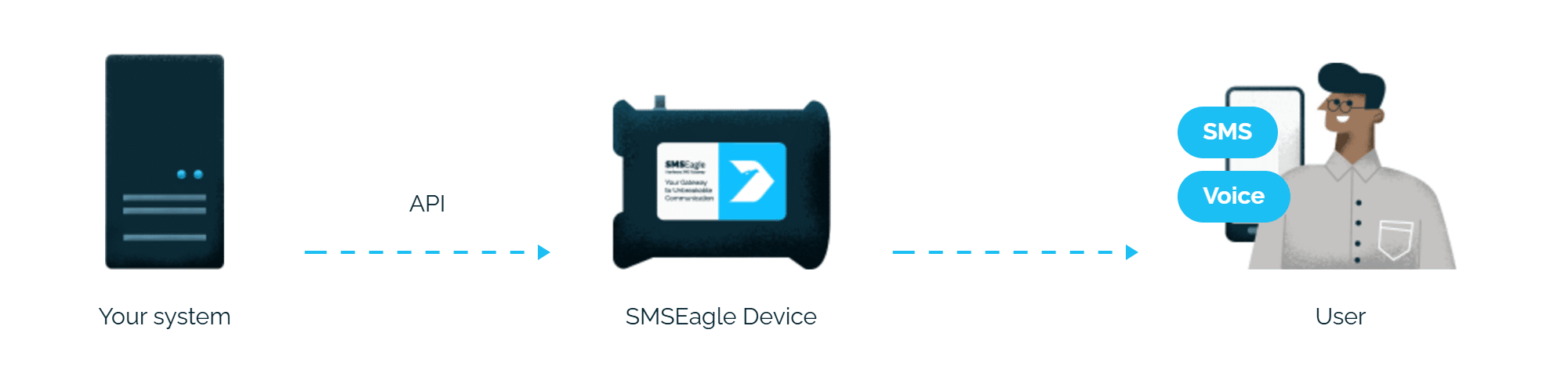
Checkmk alerts reach the person on duty as an SMS. SMSEagle sends them over its own cellular connection, so they don’t depend on internet access or a cloud service.

SMSEagle appears in Checkmk settings

After you copy the script to the server, you choose SMSEagle as the notification method in Checkmk rules.

Secure connection

Checkmk connects to SMSEagle over encrypted HTTPS with an API key, with no username or password saved in the rule.

You choose the SIM card for alerts

On devices with several modems you choose which SIM card sends Checkmk alerts.

How it works

1

Event Trigger

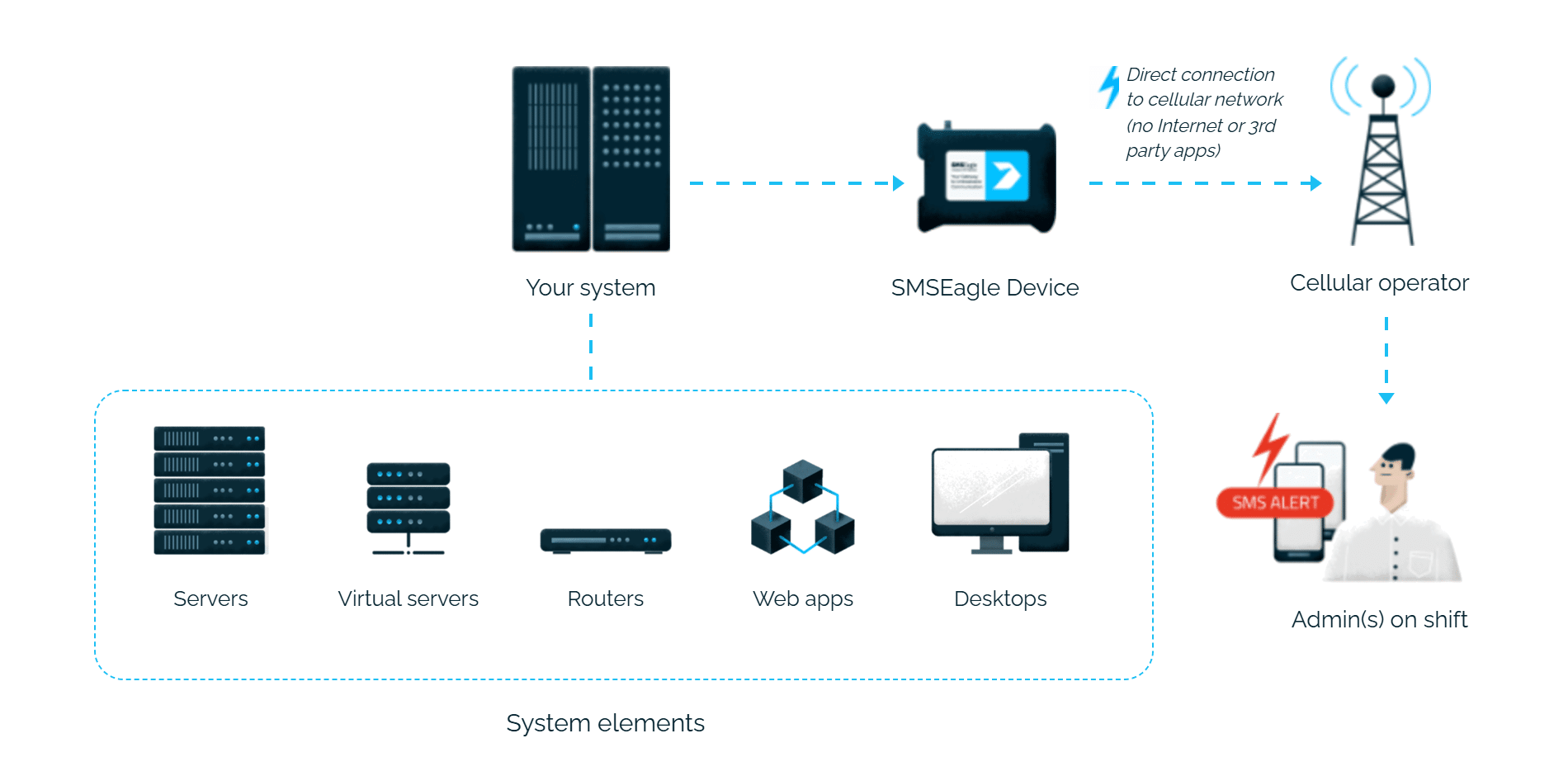
Checkmk detects a monitored condition matching a configured notification rule.

2

Communication

Checkmk’s SMSEagle notification method sends an HTTPS APIv2 request to the SMSEagle device over your local network.

3

Alert

SMSEagle delivers the alert over its own cellular connection, not through a third-party service, as an SMS to the contacts defined in the notification rule.

Set up in about 10 minutes

Requirements: Checkmk 2.x (CEE, CRE, or CME), SMSEagle firmware with APIv2 support (v5.0 or newer), and curl installed on the Checkmk server.

SMSEagle sends Checkmk alerts to the right person by SMS, day and night.

Settings for each team

Per-contact configuration (Custom User Attributes) lets different teams use different SMSEagle devices, priorities or SSL settings on the same Checkmk instance.

Urgent alerts go first

Set the SMS priority from 0 to 9 in the notification rule, so the most urgent Checkmk alerts are sent before the rest.

Alerts keep working even if one device fails

Two SMSEagle devices can work as an HA cluster: if one fails, the other takes over sending.

SMSEagle configuration

Step 1: Configure SMSEagle

    1. Log in to the SMSEagle web GUI
    2. Go to System > Users
    3. Create a new user, or use an existing one
    4. Go to Settings > Global settings > API and open the API v2 page
    5. Click Create API key, fill in Key name and select that user as Owner
    6. Enable permission for SMS sending
    7. Click Create key. The access token is shown only once, right after saving, so copy it now for later use in Checkmk
    8. Open Settings > Global settings > Network > SSL, turn off Forward HTTP to HTTPS and click Save changes.

Checkmk configuration

Requirements

Before you begin, make sure your environment includes:

    • Checkmk 2.x (CEE, CRE, or CME)
    • SMSEagle firmware with APIv2 support (v5.0 or newer)
    • curl installed on the Checkmk server

Step 2: Install the notification script in Checkmk

Copy the SMSEagle notification script to your Checkmk site and make it executable:

# Switch to your Checkmk site user
su – mysite

# Copy the script to the notifications directory
cp check_mk_smseagle-notify.sh ~/local/share/check_mk/notifications/

# Make it executable
chmod 755 ~/local/share/check_mk/notifications/check_mk_smseagle-notify.sh

# Restart the site
omd restart


This is the installation flow described in the current SMSEagle Checkmk repository.

Step 3: Create a notification rule in Checkmk

In Checkmk:
  1. Go to Setup > Events > Notifications
  2. Click Add rule
  3. Set Notification Method to SMSEagle
  4. Fill in the required parameters:
  • SMSEagle device URL
    Example: https://192.168.0.100
  • API Access Token
    Your SMSEagle APIv2 token
Optional parameters:
  • Verify SSL — yes or no
  • SMS priority — value from 0 to 9
  • Encoding — standard or unicode
  • Modem number — optional, for multi-modem devices

Step 4: Define recipients

Under Contact selection, choose the users or contact groups that should receive SMS alerts.
Make sure each contact has the Pager field filled in with a valid phone number in international format, for example:
+48123456789
 

Optional: Use Custom User Attributes

If you want more flexibility, you can define SMSEagle settings per contact using Checkmk Custom User Attributes instead of rule-level parameters.
 
Supported attributes:
  • SMSEAGLE_URL
  • SMSEAGLE_TOKEN
  • SMSEAGLE_VERIFY_SSL
  • SMSEAGLE_PRIORITY
  • SMSEAGLE_ENCODING
  • SMSEAGLE_MODEM_NO

When these attributes are defined, they take precedence over the notification rule parameters. This is useful when different users or teams should use different devices, priorities, or SSL settings.

SSL note

The integration uses HTTPS communication between Checkmk and the SMSEagle device. If your SMSEagle device uses a self-signed certificate, you can either trust that certificate on the Checkmk server or disable SSL verification in the notification parameters.

Troubleshooting

To inspect notification debug output, check the Checkmk notification log:

tail -f ~/var/log/notify.log

Debug entries are prefixed with DEBUG: and errors with ERROR:.

Legacy installations

Older environments may still use the legacy Python script notify_smseagle.py, which relies on the older SMSEagle HTTP API. That version is kept only for backward compatibility and is available in the obsolete directory of the repository.
For new deployments, use the current Checkmk 2.x integration with APIv2 token authentication.

Explore SMSEagle Demo device

SMSEagle is a hardware & software solution that guarantees a swift delivery of your messages to designated recipients, whether it’s for notifications, alerts, or important updates.

After registering to a demo you get a remote access to our physical device NXS-9750.

  • 14-days free trial
  • Access to over 20 functionalities

What is hardware
SMS Gateway?

Learn more about
SMSEagle features