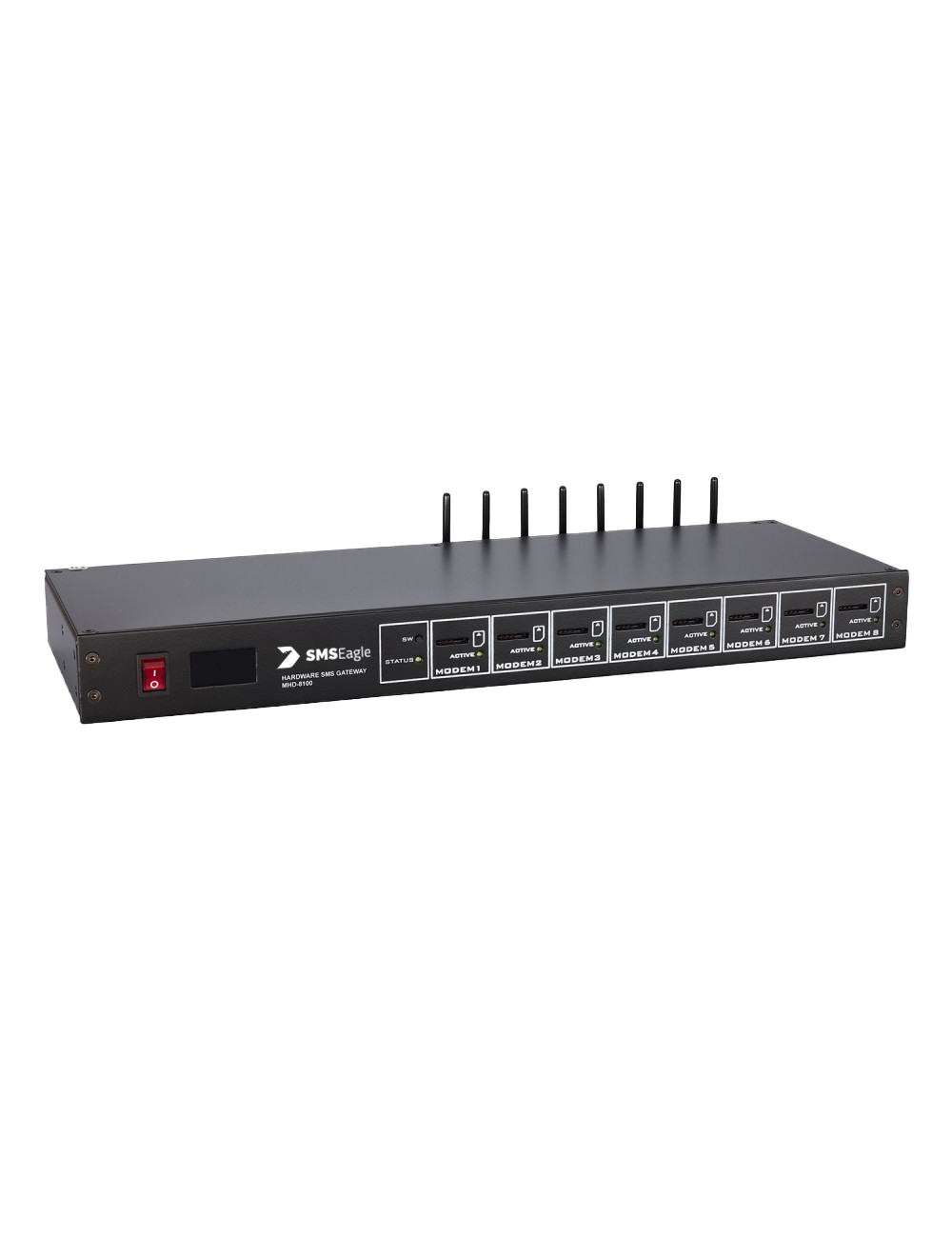
An SMS gateway connects your systems to mobile networks so they can send and receive text messages. There are two types: a hardware gateway, a device with its own SIM cards installed in your network, and an online gateway, a cloud service you pay for per message.
This page shows how they differ and when a hardware gateway is the better choice: when your data must stay in your network, when messages must go out without internet, and when you want costs that do not grow with every message.

An SMS gateway is a system that lets your applications send and receive text messages by connecting them to mobile network infrastructure, typically through an API.
Typical uses are:
There are two types of SMS gateway. They do the same job, but they reach the mobile carrier in different ways.

A physical device installed in your network, with its own built-in modems and your own SIM cards. A hardware SMS gateway sends messages through the mobile network using those SIM cards.
What is a hardware SMS gateway >

A cloud service run by a provider. It handles the carrier connection for you, and you pay for the messages you send.
That difference decides which one fits you, and the rest of this page compares them.
Not sure? Take the quiz and get a recommendation based on your volume and budget model.
| Aspect | Hardware SMS gateway | Online SMS gateway | What it means in practice |
|---|---|---|---|
| Data and control | |||
| Data privacy | Messages are processed on a device in your own network, with no third party in between | Messages are stored and processed on the provider's servers, and security depends on the provider's measures | You keep control of contact lists, message content and logs. See the data privacy section below. |
| Security measures | You control access to the device, with user roles, multi-factor authentication and allow or deny lists | Depends on the provider's security measures and your internet connection | Access control stays with your team. |
| Internet dependence | |||
| Works without internet | Yes, built-in modems send and receive over the mobile network | No, it needs a stable online connection | Alerts still go out when your internet link fails. |
| Costs | |||
| Initial costs | Purchase of the device | No initial investment | Hardware needs a budget up front. The cost section below shows where it pays off. |
| Recurring costs | Your own SIM contract with the carrier you choose, a fixed monthly payment | A price for each sent SMS, plus a subscription fee per phone number for incoming SMS | Hardware costs stay predictable. Online costs rise with every message. |
| Speed and sender | |||
| Sending speed | Up to 30, 60 or 240 SMS per minute, depending on the model | Above 2,000 SMS per minute | Check your peak volume. Very large one-off bursts are easier online. |
| Sender ID | Messages leave from your SIM number, so the sender ID cannot be changed | The sender ID can be changed | Choose online if you need a custom sender name. |
| Two-way communication | Replies come back to you | Two-way communication is impossible when the sender ID is changed | Choose hardware if you need replies. |
| Integration and features | |||
| API | Yes, a REST API (API v2) to send and receive SMS from your applications | Yes | Both connect to your software. |
| Email to SMS | Built into the gateway | Offered by some services, not all | Existing email alerts can be turned into SMS. |
| Features and automations | A wide range, including Workflow Builder, SMS Forward and Autoreply, and the software is regularly updated | Limited ability to cater to specific needs | More ways to automate your messaging. |
| Custom features | Software can be adjusted to a customer's specific needs | Limited advanced customization | You can shape the gateway to your process. |
With a hardware SMS gateway, your messages do not leave your network on the way to the mobile network. The device is installed on your premises and processes messages locally.
Contact lists, message content and logs stay inside your own network, with no third-party service in between. With an online SMS gateway, messages are stored and processed on the provider’s servers, so security depends on the provider’s measures and on your internet connection.
You manage access to the device yourself. Set administrator and user roles, require multi-factor authentication by SMS or an authenticator app, allow or block numbers with allow and deny lists, and connect to LDAP or Active Directory.
SMSEagle maintains an information security management system certified under ISO/IEC 27001:2022 and develops its software with a secure software development lifecycle.
Read more: Security & Compliance and Trust Page.
An online gateway charges for every message you send, so your bill grows with your volume. A hardware gateway is a one-off purchase, so the cost per message falls the more you send. The point where the two meet is your break-even point. The result divides the price of an SMSEagle hardware gateway by what you pay for SMS today. It does not include your own SIM tariff, so check it against your carrier’s rates.
You can test a physical SMSEagle device for free for 14 days. See how 40+ built-in features, from Email to SMS to network monitoring, fit your workflow.
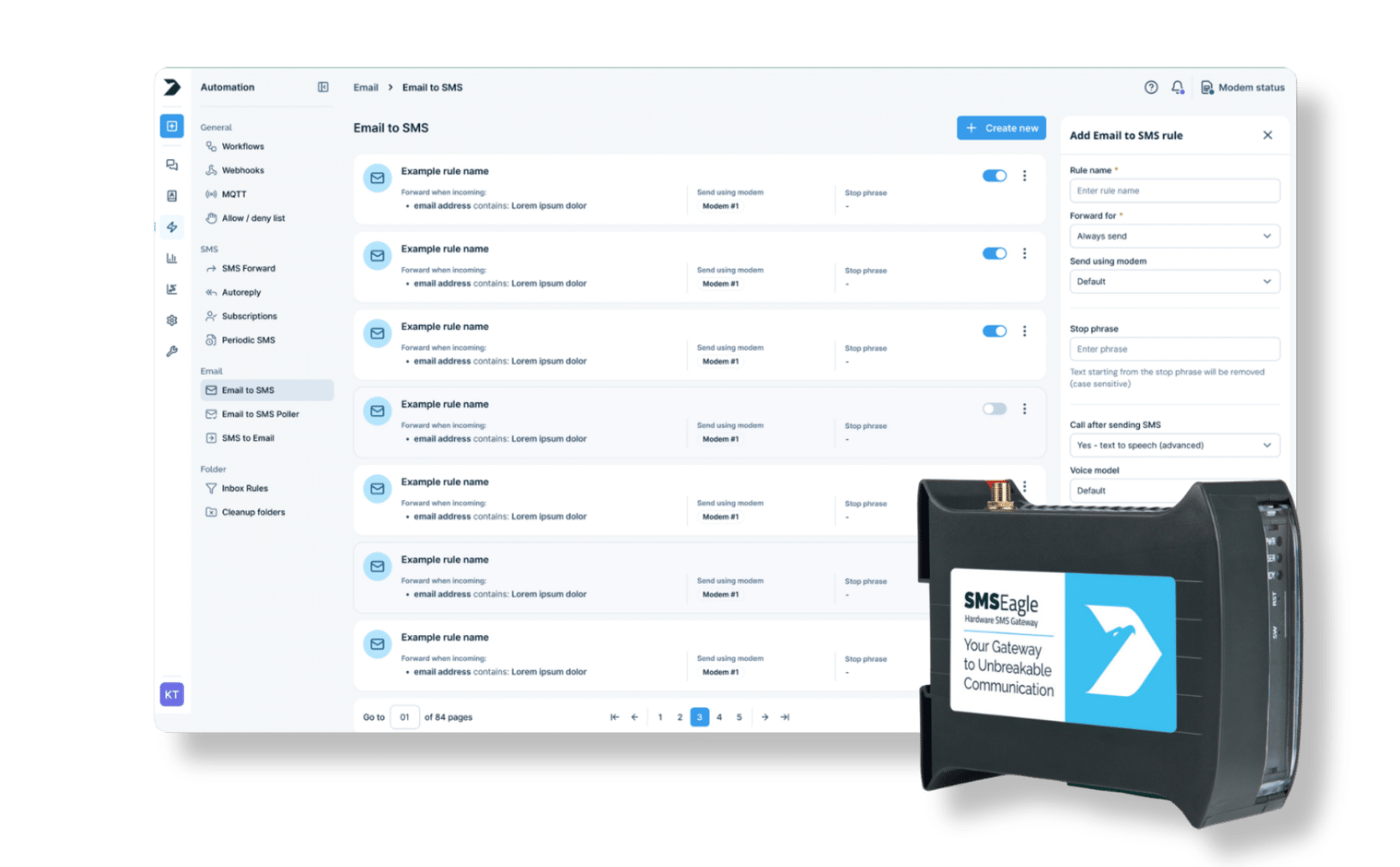
Read more: Online vs offline SMS gateway.
The right series depends on how many messages you send per minute and whether you need a backup modem: from 30 SMS/min on a single modem up to 240 SMS/min on the eight-modem model.
Insert your own SIM cards and connect the gateway to your network.
Send messages from your monitoring or business tools with Email to SMS, the API or a ready-made integration plugin.
Not sure which series fits? Compare all models. Want to see it first? Try the online demo.
An SMS gateway connects your software and devices to mobile networks so they can send and receive text messages. It can be a hardware device with SIM cards or an online service.
A hardware SMS gateway is a device with built-in modems and your own SIM cards, installed in your network, so you pay once for the device and then your own SIM contract. An online SMS gateway is a cloud service that charges for each sent SMS, plus a subscription fee per phone number for incoming SMS.
It depends on your volume. A hardware gateway has an initial cost, and after that you pay only your SIM contract, so it tends to pay off as volume grows. Use the calculator on this page to see how fast it pays off for you.
A hardware SMS gateway can. It sends and receives messages through built-in modems over the mobile network, so it does not depend on an internet connection. You need active SIM cards and mobile coverage. An online SMS gateway needs a stable internet connection.
With a hardware SMS gateway, messages are processed on a device in your own network. With an online SMS gateway, messages are stored and processed on the provider’s servers, and security depends on the provider’s measures.
No. Messages leave from your SIM number, so replies come back to the same number and two-way communication works. Online SMS gateways can change the sender ID, which makes two-way communication impossible.
Up to 30 SMS per minute on a single-modem model, up to 60 on a dual-modem model and up to 240 on the eight-modem model.
Answer a few questions about your message volume, budget model and security needs, and see whether a hardware or an online SMS gateway is the better fit. Or tell us about your setup and we will help you choose.