A hardware SMS gateway is a physical device that enables sending and receiving SMS messages directly through mobile networks, without using cloud services or an Internet connection. Secure, independent, and reliable. Discover how a hardware SMS gateway ensures 100% data privacy and enables mission-critical communication.
A hardware SMS gateway acts as a bridge between your internal infrastructure and telecommunications networks. A built-in modem with your SIM card connects to the mobile network, much like a mobile phone does. The gateway sends and receives text messages to and from the SMSC or IMS (a special server inside the operator’s network), which then forwards them to mobile phones.
A physical device operating locally on your premises for maximum control.
A cloud-based service that requires a constant internet connection.
Choosing a hardware-based solution means your communication is entirely independent. Because it uses built-in radio modules and physical SIM cards, it remains fully operational even during internet outages or external server failures. It’s the gold standard for industries where security and uptime are non-negotiable.
Hardware SMS gateways work without Internet access, ensuring reliable delivery of critical messages in offline or isolated environments.
All communication and sensitive data remain within the company’s own infrastructure, reducing reliance on external providers and supporting data privacy requirements.
Using a hardware SMS gateway removes the ongoing subscription and per‑message fees. This results in predictable costs and makes the solution particularly economical. See how much you could save with our affordability calculator.
Hardware SMS gateway
Online SMS gatewayThe right series depends on how many messages you send per minute and whether you need a backup modem.
One built-in modem. A compact gateway for basic needs, handling up to 30 SMS per minute. Available in 4G and 5G.
Two built-in modems and up to 60 SMS per minute. If one modem loses its network connection, the other takes over, including messages waiting in the queue. Modem failover needs two active SIM cards.
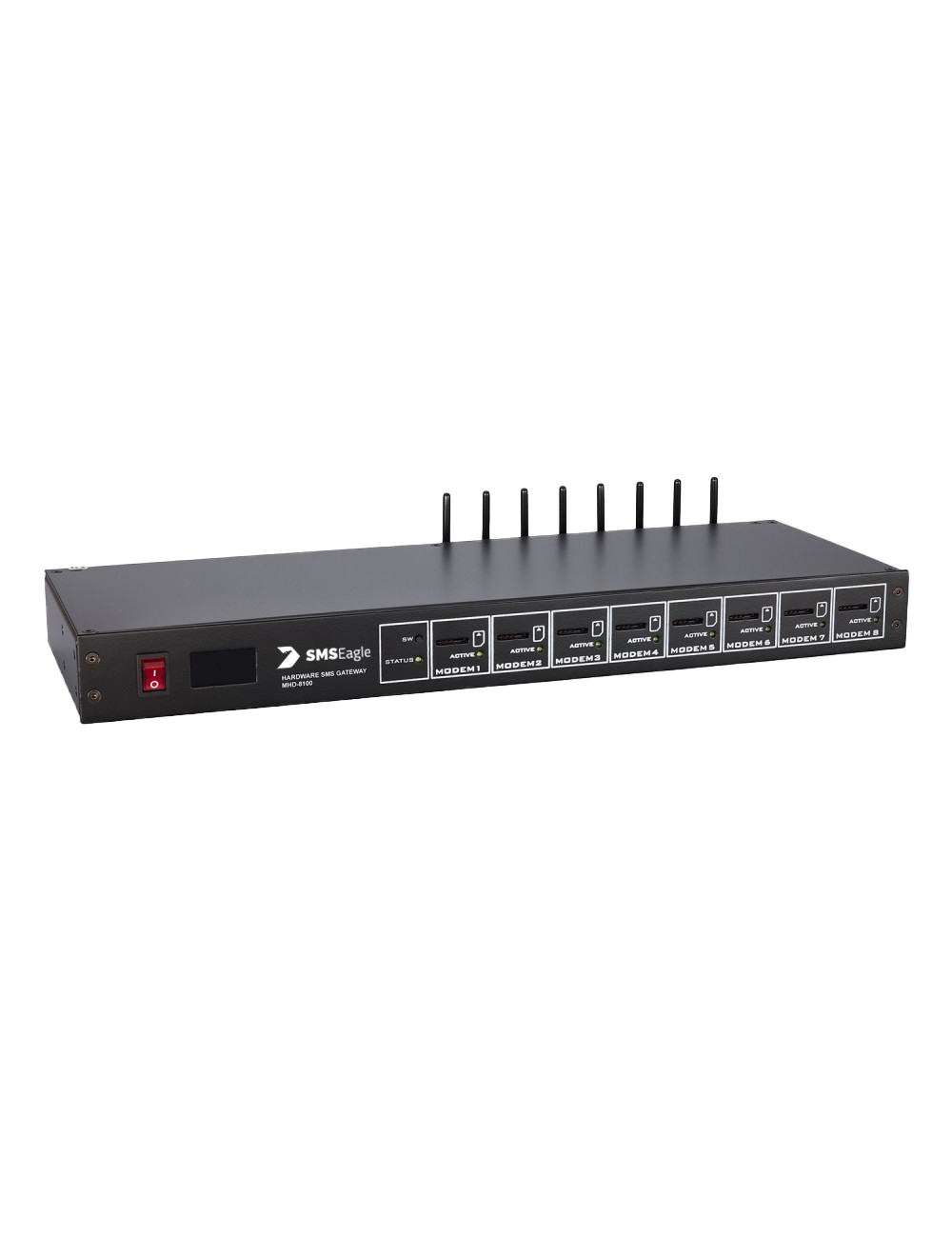
Eight built-in 4G modems for high volumes: up to 240 SMS per minute, with modem failover across your SIM cards. Built for enterprise-grade throughput.
SMS throughput refers to the rate at which an SMS gateway can send SMS texts and receive SMS. It is measured in SMS messages per minute. The higher the SMS throughput, the more messages can be handled at a given time. SMS throughput is determined by the capacity of the SMS gateway, the speed of its communication channels, and the processing power of the device.
3G/4G/5G are mobile network technologies used for wireless communication. The main difference between them is the speed and bandwidth they offer. 4G technology is newer and offers a greater range. 3G technology is slowly being phased out.
Modem Failover is a feature that allows to switch to a backup modem in case the primary modem fails. This feature ensures continuous operation of the SMS gateway hardware and minimizes the risk of downtime or message delivery failure. With Modem Failover, businesses can ensure that their device is always operational, even if one of the modems fails.
Not sure which series fits? Compare all models or see pricing.
We maintain a certified Information Security Management System (ISMS) in compliance with ISO/IEC 27001:2022 and follow EN 18031 and GDPR requirements. Our devices are certified for major global markets: CE, FCC, ISED, UKCA, PTCRB, RCM, IMDA, TDRA, CB Scheme, and carrier-approved by Verizon and AT&T.
We log, rank, and address reported security issues seriously and swiftly. Vulnerability reports are acknowledged and resolved following a structured incident response process, including documentation and system updates.
We deliver consistent software updates, enhancing both functionality and security. Updates are accessible through the web GUI, ensuring your device remains current with the latest defenses.
You need to purchase an SMS gateway hardware device that meets your communication requirements. See SMSEagle pricing.
You need a SIM card from a mobile network provider that supports SMS messaging. The SIM card should be inserted into the hardware SMS gateway device to enable it to send and receive text messages.
1
Purchase SMSEagle device
2
Insert your SIM card into SMSEagle
3
Connect SMSEagle to your computer network via LAN
4
Access your SMSEagle from a web browser or any external system without Internet.
With a web-GUI, users can send messages directly from their web browser. This use scenario is suitable for businesses that need to send occasional text messages, such as appointment reminders, messages to employees or clients, promotional messages. Using the web-GUI for SMS messaging can improve customer engagement by enabling direct, timely communication with clients and customers. Users can log in to the web-GUI and send messages to one or more recipients.
An API (Application Programming Interface) allows developers to integrate SMS messaging capabilities into their software applications. This use scenario is suitable for businesses that need to send automated text messages, such as transactional messages or SMS alerts. Developers can use API to send messages from their applications or systems.
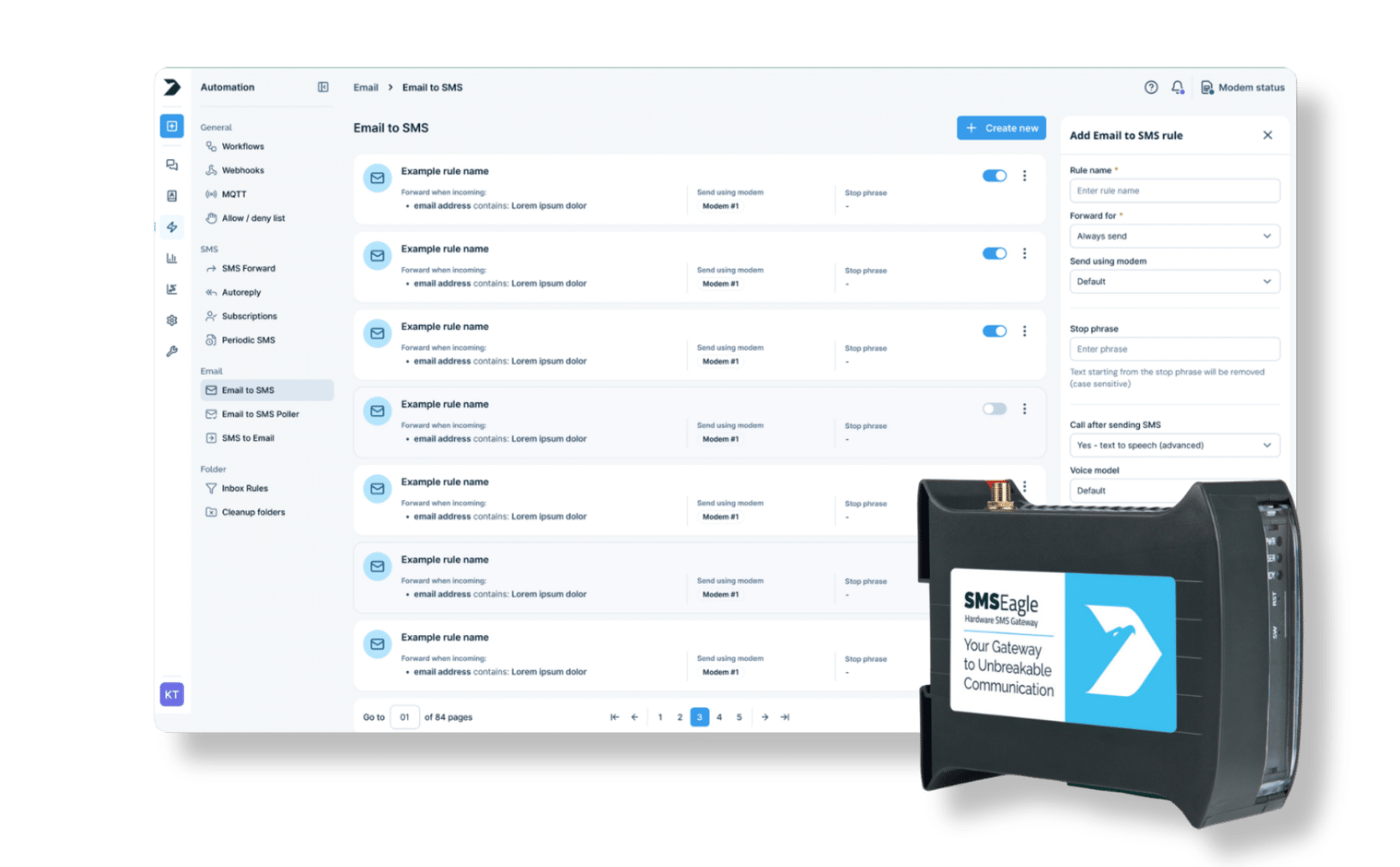
With Email to SMS, users can send SMS messages from their email accounts, e.g. Outlook. This is the perfect solution for IT teams and business-critical communications, ensuring important notifications are delivered reliably. Users can send messages by composing an email and sending it to a specific email address associated with the SMS gateway. The service will then convert the email to an SMS message and send it to the recipient’s phone number.
CEO & Product Lead at SMSEagle
"We designed SMSEagle specifically for organizations that can't afford to send sensitive data through third-party servers — but still need reliable SMS communication. The hardware-first approach wasn't just a technical choice. It was a direct response to what IT admins and compliance teams kept running into with cloud-based services: dependency, recurring costs, and no real control over where their data goes."
Hardware SMS gateways are a versatile solution capable of handling high messaging volumes efficiently, making them cost‑effective for businesses that need to send large quantities of messages without recurring online service fees. These gateways are commonly used by organizations of all sizes, including small businesses, large enterprises, and government agencies, for applications such as two‑factor authentication, customer engagement, and internal communication.
IT Professionals
Send alerts and tokens from IT infrastructure
Building Automation
Send immediate alerts on infrastructure failures from BMS
Healthcare
Remind patients about upcoming appointments
Schools
Inform about closures and emergencies
Government
Send information to employees with full data confidentiality
Factories
Send important equipment updates to employees
Customer Service
Inform customers about sales, offers and order status
Transportation
Communicate with drivers of public and private vehicles while on the road
You can test a physical SMSEagle device for free for 14 days. See how 40+ built-in features, from Email to SMS to network monitoring, fit your workflow.
A hardware SMS gateway keeps everything inside your own network. Messages go directly from your infrastructure to the mobile carrier via a SIM card – no third-party servers involved, no data leaving your organization. You control the device, the data, and the access.
On the software side, SMSEagle adds additional layers: multi-factor authentication (MFA), user access controls, LDAP integration, and a blacklist feature to block unwanted numbers. Our devices run on a Linux operating system, which provides stability and security. We are also ISO 27001 certified, which matters when procurement or compliance teams ask questions.
Yes – a hardware SMS gateway can work without internet access. SMSEagle gateway sends messages directly to mobile networks using SIM cards and cellular connectivity (2G/3G/4G/5G), not via the public internet. This makes it ideal for offline, isolated, or high‑security environments.
Hardware SMS gateways with modem failover handle this automatically — if the primary modem fails, the device switches to a backup modem without any manual intervention.
An SMSEagle hardware SMS gateway can send from 30 up to 240 SMS per minute, depending on the model. Single‑modem devices support up to 30 SMS/min, dual‑modem devices up to 60 SMS/min, and eight‑modem models up to 240 SMS/min.
Yes. SMSEagle supports integration with tools like Zabbix, PRTG, Nagios, LibreNMS, and others. You can also integrate with your own apps using email triggers, the API, SNMP, or webhooks. It works with a wide range of systems: monitoring tools, ERP systems, authentication systems (MFA/2FA), and custom-built applications. There are also ready-made integration plugins available for popular platforms.
Some online SMS gateway services offer free tiers, but they’re typically very limited – a few hundred messages per month, with branding, no two-way communication, and no guarantees on delivery. For anything business-critical, free services tend to fall short quickly.
A hardware SMS gateway like SMSEagle has an upfront device cost, but once you own it, there are no recurring platform fees. You just pay for your SIM card plan. For organizations sending a consistent volume of messages, it ends up being significantly cheaper than subscription-based services.
It depends on what you actually need. For marketing campaigns, bulk SMS, or consumer-facing messaging, a cloud-based SMS gateway service is usually the easier choice — fast to set up, pay-per-message, no hardware required.
For organizations that need data privacy, offline operation, or integration with internal systems (monitoring tools, authentication, industrial equipment), a hardware SMS gateway is a better fit. It gives you full control over your SMS communication without routing anything through external servers. SMSEagle is one of the few dedicated hardware options that combines this with a proper API, email integration, and multi-modem support for higher volumes.
The “best” option is the one that matches your infrastructure — not necessarily the most popular one.
The right model depends on your message volume and on how much redundancy you need. See what each series costs or tell us about your setup and we will help you choose.