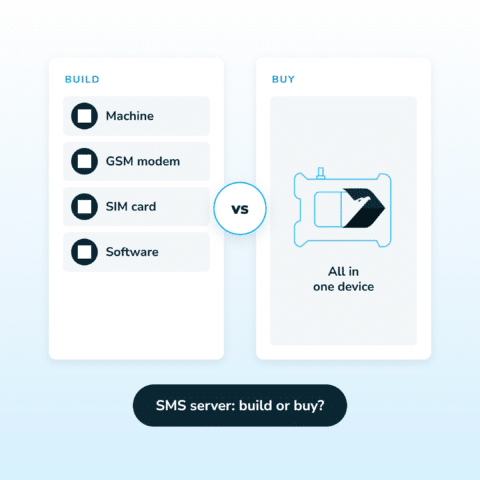
SMS server: what it takes to build one, and when to buy instead
If you are looking for an SMS server, you are usually one of two people: someone who wants to run the software themselves, or someone
If you need SMS that keeps working when your internet connection is down, or message data that never leaves your own network, SMSEagle is the on-premise alternative to Twilio: a hardware SMS gateway with its own SIM cards, installed in your infrastructure and sending over the cellular network. Twilio is the better choice when you need global reach across many countries and channels without owning hardware. The two products solve different problems. SMSEagle is built for alerting and critical notifications from systems you run yourself. Twilio is built for application messaging at global scale.
Twilio is a cloud communications platform. Your application calls an API over the internet and Twilio’s infrastructure handles delivery. For most application messaging that is exactly what you want.
Three situations change the calculation:
A note on terminology. Twilio does document on-premises connectivity, but that refers to SIP trunking, which links an on-premises PBX to Twilio’s network for voice. There is no self-hosted version of Twilio’s SMS service: messages go through Twilio’s cloud.
SMSEagle is a physical device you install in your own network, with one or more SIM cards from your own mobile operator. Your systems reach it over the LAN through an API, Email-to-SMS, or one of the ready-made integration plugins. The device sends the message directly over the cellular network.
Current models:
| Model | Modems | Throughput | Typical use |
|---|---|---|---|
| NXS-9700 | 1 | up to 30 SMS/min | single site, straightforward deployment |
| NXS-9750 | 2 | up to 60 SMS/min | SIM redundancy across two operators |
| MHD-8100 | 8 | up to 240 SMS/min | high volume, multiple SIM redundancy |
All models run the same software platform, currently version 7.0.3, with free updates during the warranty period.
Yes, and for many customers this is the deciding factor.
SMSEagle needs three things: power, cellular coverage, and a local network connection to the systems that send messages. None of those is your internet uplink.
A concrete example. Your monitoring server (Zabbix, Nagios, PRTG, whichever you run) sits in the same server room as the gateway. The WAN link goes down. The monitoring system detects it, calls SMSEagle over the LAN, and the alert goes out over the mobile network. Nothing in that path touched the internet. With a cloud platform, the same outage removes your ability to send the alert about the outage.
The honest limitation: SMSEagle needs mobile network coverage at the installation point. In a basement data centre or a shielded room that can mean fitting an external antenna. Cellular coverage is a requirement, not an optional extra.
With SMSEagle, message content, recipient numbers and delivery logs stay on the device, inside your network. No third-party platform processes them on the way.
This matters for two reasons that come up regularly in procurement:
Two things to be precise about. Your mobile operator carries the SMS, as it does for every message on a cellular network, so this means no additional application-layer processor, not secrecy from the carrier. And compliance depends on your whole setup, not on a single device: this removes a dependency, it does not by itself make a deployment compliant.
Security features on the device include user roles, MFA by SMS or authenticator app, LDAP and Active Directory integration, allow and deny lists, and SSL certificate management.
SMSEagle is a hardware & software solution that guarantees a swift delivery of your messages to designated recipients, whether it’s for notifications, alerts, or important updates.
The two models are structurally different, which is why a direct per-message comparison rarely settles the question.
SMSEagle: a one-time hardware purchase, then the cost of SMS from your mobile operator, usually a business tariff or bundle on the SIM. All software features are included in the device price, with no per-feature licensing and no subscription. Software updates are free during the warranty period.
Twilio: pay as you go. You pay per message, plus phone number rental, with rates that vary by destination country and route.
Where the line falls depends on your volume, how many countries you send to, and how long you plan to run the system. Steady, predictable traffic from one or two locations tends to favour owned hardware over a few years. Spiky, unpredictable, worldwide traffic tends to favour the cloud. Rather than take our word for it, run your own numbers in our affordability calculator.
SMSEagle hardware SMS gateway can be 3x cheaper compared to online SMS gateways. One-time payment grants you access to all features, there are no subscription fees and hidden costs.
| SMSEagle | Twilio | |
|---|---|---|
| Deployment | hardware in your network | cloud service |
| Works without internet access | yes | no |
| Where message data is processed | on your device | Twilio’s infrastructure |
| SMS, MMS, two-way messaging | yes | yes |
| Voice calls | yes (VOICE add-on) | yes |
| yes | yes | |
| Signal | yes (Rev.4 and newer) | no |
| Global reach without local SIM cards | no | yes |
| Video, IVR, contact centre tooling | no | yes |
| Network monitoring, SNMP agent | yes | no |
| Digital I/O, temperature sensors | yes | no |
| Ready-made integration plugins | 100+ systems | API first |
| Pricing model | one-time purchase plus operator SMS cost | per message plus numbers |
| Throughput | 30 to 240 SMS/min depending on model | no practical ceiling |
SMSEagle and Twilio offer reliable customer support, with dedicated teams available to assist businesses with any issues or inquiries. SMSEagle’s support first reply on average within 24 minutes and customers consistently rate it 5/5 on Google. Moreover, the fact that 42% of tickets are resolved after just one message is something they can be proud of.
We would rather you bought the right tool than our tool. Twilio is the better fit when:
SMSEagle fits the opposite profile: a defined set of recipients, systems you operate yourself, and a requirement that the channel works when other things are failing.
Is SMSEagle a drop-in replacement for Twilio?
Not in general. If you use Twilio for SMS alerts and notifications from systems you run, SMSEagle covers that, and you move from an HTTP call to Twilio’s cloud to an HTTP call to a device on your LAN. If you use Twilio for global application messaging, IVR or video, there is no equivalent.
Does SMSEagle really work with no internet connection?
Yes. It needs power, cellular coverage and a LAN connection to the systems that send messages. The internet uplink is not in the path. This is the main reason it is used for infrastructure alerting.
Where is message data stored?
On the device, in your network. Content, numbers and logs do not pass through any third-party messaging platform. Your mobile operator carries the SMS itself, as with any cellular message.
How many messages can it send per minute?
From 30 SMS/min on the single-modem NXS-9700 up to 240 SMS/min on the eight-modem MHD-8100. If you need more, several devices can run in parallel.
The choice is not about which platform is better in the abstract, but about where the messages have to come from. If your SMS has to leave from inside your own network, keep working during an outage, and keep message data out of third-party hands, that is what a hardware gateway is for. If you need global reach and a wide channel mix without owning equipment, Twilio does that well.
If you want to see SMSEagle on real hardware before deciding, we run a free 14-day trial on a live demo device, with no credit card required.
Last updated: 4 November 2026. Software version referenced: 7.0.3.

If you are looking for an SMS server, you are usually one of two people: someone who wants to run the software themselves, or someone


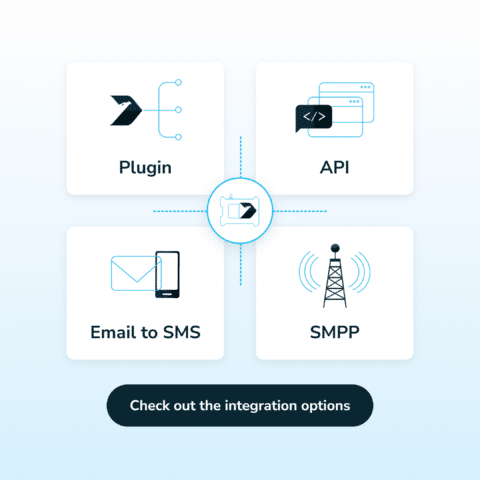
Integrating an SMS gateway means connecting your software to it, so the software can send text messages and receive replies automatically. There are four main ways to do it: a ready-made plugin, an API, Email to SMS and SMPP.
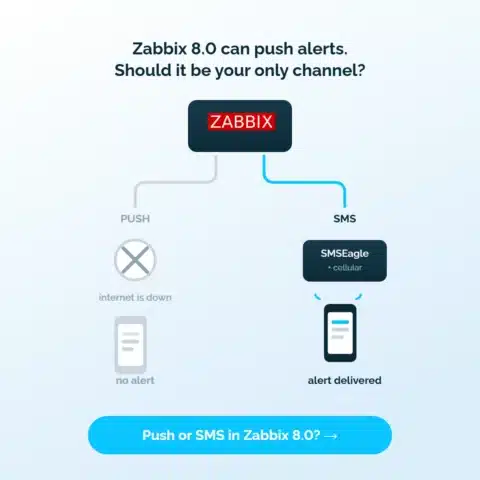
Zabbix 8.0 adds push notifications and a mobile app. Here is what the architecture depends on, where it breaks, and why SMS and voice alerts still belong in your escalation chain.

Engineer by education, marketer by choice. For 6+ years I've combined technology, data, and content marketing to help companies gain a competitive advantage and achieve measurable results. As a Technical Content Specialist at SMSEagle, I develop brand messaging and content that support sales, customer education, and market positioning. A degree in Information Systems gave me a unique perspective at the intersection of business and technology. I believe quality is the only thing worth scaling.